Chapter 16 · Part IV — The Infinity Engine and Governed Recursion
From Loop to Engine
#Opening signal
The Fibonacci recurrence, run once, gives you one term. Run repeatedly, it gives you a sequence — but "run repeatedly" hides an enormous amount. How the repetition is governed determines whether the result is a trustworthy sequence or an accumulating mess. A loop is just repetition. An engine is repetition with a frame, a cycle, an evidence store, and a gate — repetition that produces not only states but the evidence that each state is sound. This chapter assembles the pieces from Parts II and III into a single governed machine and gives it its diagram.
#Mathematical core
FACT. Iterating the Fibonacci recurrence is the mathematical archetype of a governed loop. Each iteration: recovers the required prior state (the preserved pair), applies the principal (the recurrence), produces a candidate, validates it (against the recurrence and invariants), preserves it with derivation, and tracks it in the indexed ledger. The sequence is the output; the ledger with provenance is the durable value. Run the same recurrence without preservation and validation and you get the same numbers but none of the trust — you cannot audit, recover, or reverse. The engine is the difference between a sequence you computed and a sequence you can stand behind.
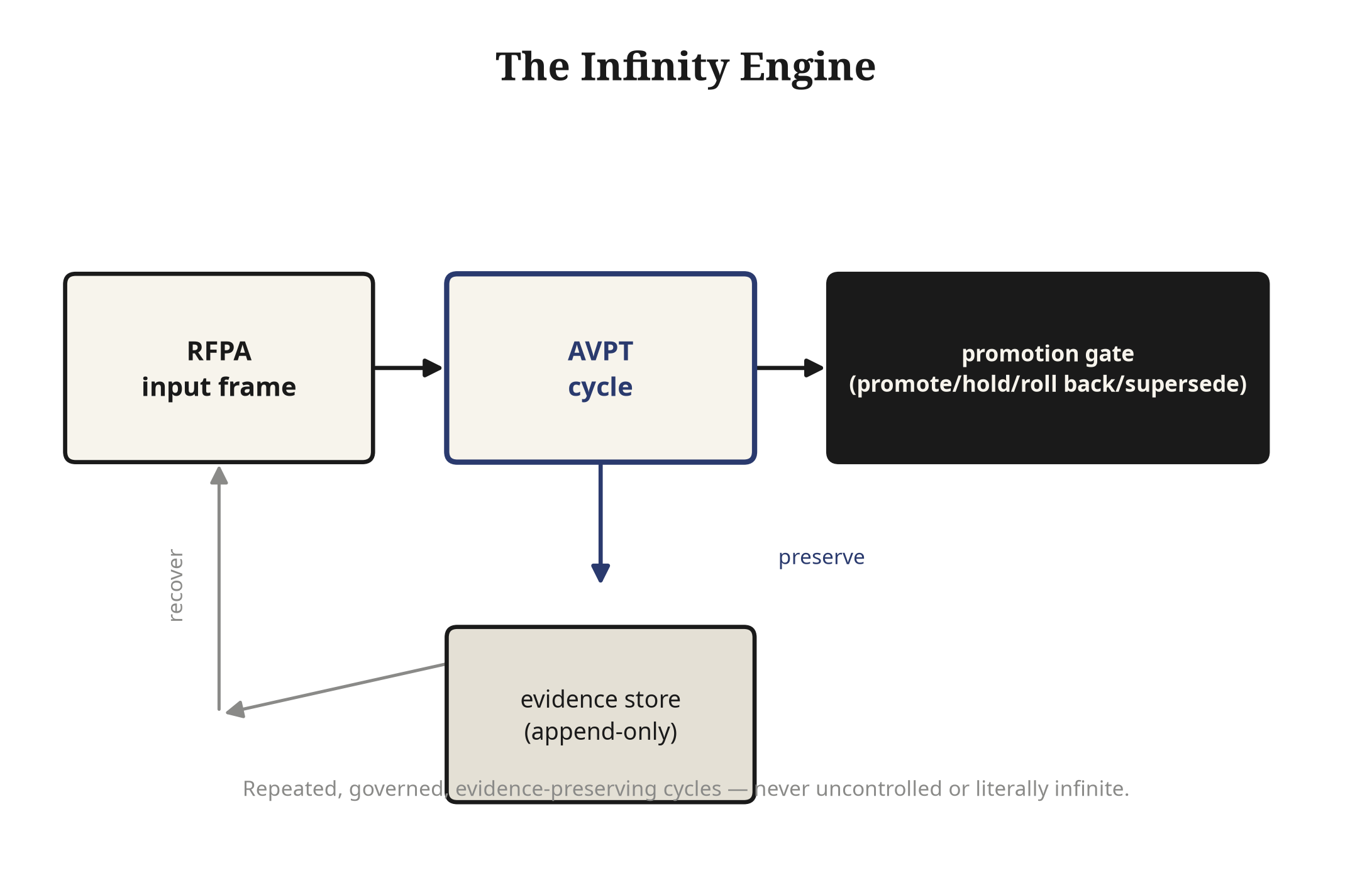
FACT. The engine has a definite structure, and it is worth stating as a system:
- an input frame (RFPA: the recovered state, declared field, named principal, registered assumptions);
- a cycle (AVPT: attempt, validate, preserve, track);
- an evidence store (the append-only chain of preserved packets); and
- a promotion gate (the four-outcome decision point).
The cycle feeds the evidence store; the evidence store feeds recovery on the next turn; the gate decides what enters the canonical sequence. This is a closed, governed loop, and its diagram (Figure — The Infinity Engine) shows exactly these four components with the flow between them.
#Odisena translation
CANON. The Infinity Engine is the composition of the RFPA frame and the AVPT cycle into repeated, governed, evidence-preserving turns, mediated by an evidence store and a promotion gate.
METHOD. Build the engine as a system, not a habit. Wire the four components together so that the cycle cannot run without a frame, cannot promote without the gate, and cannot proceed without preserving to the evidence store. When the components are wired, discipline stops depending on memory and starts depending on structure. The Odisena AVPT CI/CD dashboard is a concrete engine of this kind: it combines a webhook receiver, a durable ledger, an observability stack, a reusable workflow, snapshot adapters, and a view that compares AVPT-governed cycles against naive linear execution — the frame, cycle, evidence store, and gate rendered as running software.[43]
#Boundary note
INTERPRETATION. Calling it an "engine" invites the misreading that it runs itself — set it going and walk away. It does not, and should not. The interpretation I hold: the engine automates the bookkeeping of governed growth — the preservation, the tracking, the invariant checks — precisely so that human judgment can be spent where it matters, at the gate. An engine that also automated the gate for irreversible changes would not be a better engine; it would be an ungoverned loop wearing an engine's diagram. The automation serves the governance, never replaces it.
#Applied CASE
CASE. Contrast two teams shipping the same feature ten times over a quarter. Team A runs a loop: deploy, and if it breaks, scramble. Their tenth deploy is no safer than their first, because nothing accumulated. Team B runs an engine: each deploy recovers the prior state, validates against invariants, preserves a snapshot, tracks the result, and gates promotion. By their tenth deploy they have an evidence store of nine preserved states, a validation suite hardened by nine cycles, and a mean recovery time they can actually measure. The AVPT-versus-linear comparison view built into the Odisena dashboard exists to make exactly this difference visible — to show that governed cycles trade a little per-cycle overhead for a dramatic reduction in incident-recovery time.[43] The engine's value is not in any one turn; it is in what the turns leave behind.
#Failure mode
The failure mode is the loop mistaken for an engine: repeating a cycle without the frame, evidence store, or gate, so that repetition accumulates risk instead of trust. The tenth iteration is as fragile as the first because nothing was preserved and nothing hardened. A subtler failure is the partial engine, where preservation and tracking exist but the gate is collapsed (Chapter 15) or the frame is skipped (Chapter 10) — the diagram is there, but a component is hollow, and the missing component is exactly where the next failure enters. The fix is to wire all four components so the cycle structurally cannot skip one.
#Reusable protocol — The Engine Assembly Diagram
Assemble and verify the four components:
- Input frame (RFPA). Confirm the frame is set and gates the cycle — no frame, no cycle.
- Cycle (AVPT). Confirm each beat runs and feeds the next.
- Evidence store. Confirm every accepted state is preserved append-only and feeds next-turn recovery.
- Promotion gate. Confirm the four-outcome gate mediates entry to the canonical sequence.
- Wiring check. Confirm the cycle cannot run without a frame, cannot promote without the gate, and cannot proceed without preserving. Draw the flow; find the hollow component.
#Validation questions
- Does your repeated process have all four engine components, or is it a bare loop?
- Which component, if any, is hollow — present on the diagram but not actually enforced?
- Can you show that your tenth cycle is safer than your first, with evidence?
- Is any part of your gate automated for irreversible changes — and should it be?
#Overhead is the price of trust, and it is worth paying
INTERPRETATION. The honest objection to the engine is that it is slower per cycle than a bare loop. Framing, validating, preserving, tracking, and gating all take time that a reckless forward-only loop does not spend, and for a single cycle the reckless loop wins on speed every time. The engine's defenders sometimes pretend this overhead does not exist; it does, and pretending otherwise loses the argument with exactly the practical people the method most needs to convince. The correct response is not to deny the overhead but to locate its payoff correctly: the overhead is paid per cycle, but the payoff accrues across cycles and especially at failures. A bare loop is faster until the first failure, at which point it pays, all at once, the enormous cost of having preserved nothing — the scramble, the guesswork, the unrecoverable state. The engine pays a little on every cycle and almost nothing at failures, because failures are handled by rollback to a preserved state, a rehearsed and bounded operation. Over a system's life, dominated as it is by the cost of its worst days, the engine wins decisively; over a single good day, the bare loop wins. The mistake is to evaluate the trade on a single good day.
This is precisely why the AVPT-versus-linear comparison view exists in the Odisena dashboard: to make the cross-cycle payoff visible, so the per-cycle overhead is judged against the recovery-time savings it buys rather than in isolation. Without that comparison, the overhead is salient (you feel it every cycle) and the savings are invisible (they show up only at failures, which are rare and easy to attribute to bad luck rather than to the absence of governance). Making the savings visible is not a cosmetic feature; it is what allows a team to make the trade-off rationally instead of abandoning the engine the first time someone complains that it is slower. The engine's overhead is the premium on an insurance policy, and like all insurance the premium is visible and the payout is not — until the day it is the only thing between you and ruin.
INTERPRETATION. Underneath the components and the diagrams, the Infinity Engine represents a change in how a system relates to its own past and future, and naming that change makes the whole apparatus easier to hold in mind. A bare loop lives entirely in the present: it has a current state, it produces a next state, and the past is gone the moment it is superseded. The engine, by contrast, lives in a thick present that includes its preserved past and its bounded future. Its past is present in the evidence store, available for recovery, comparison, and audit. Its future is present in the termination policy, which declares in advance the conditions under which the run will end. The engine is, in this sense, a system that has extended itself in time — that carries its history with it and commits to its horizon before it starts — rather than a system trapped in an eternal, amnesiac now. Every component is, at bottom, a mechanism for keeping the past and the future present: the evidence store keeps the past, the termination policy keeps the future, the frame connects them by declaring what the present run inherits and what it is for. A system that can answer both "how did I get here?" and "where does this end?" is a system you can trust to grow; a system that can answer neither is a system you can only hope about.
#Bridge
We have an engine that runs governed cycles. But its name — Infinity Engine — raises the question the next chapter must answer head-on: does it run forever? The word "infinity" is doing careful work here, and misreading it turns a disciplined method into a fantasy of endless, unbounded execution. The next chapter draws the line between infinity as a direction and infinity as a deadline that never comes.