Chapter 13 · Part III — AVPT: The Cycle That Grows the System
Preserve the Provenance
#Opening signal
Return to the recurrence ledger of Chapter 2, and to its third column — the derivation. The numbers alone are the sequence; the derivation is the provenance, the record of how each term was produced. A term with its provenance can be audited, recomputed, and rolled back. The same term, stripped of provenance, is just a number: correct, perhaps, but no longer trustworthy, because trust is not a property of the value, it is a property of the value plus the evidence for it. Preserve is the beat that keeps the evidence — and it is the beat most often skipped, because the value looks complete without it.
#Mathematical core
FACT. To preserve a Fibonacci term fully is to keep more than the number. It is to keep: the value ; its two predecessors (so it can be recomputed and reversed); the operation that produced it; the validation results that cleared it; and the index/version that locates it in the sequence. With all of this preserved, any term is a self-contained evidence packet — you can hand to a stranger with its provenance and they can verify it without trusting you. Preserve only the value and you have handed them a claim.
FACT. Preservation also enables the reversibility we noted in Chapter 6. Because the recurrence is invertible given an adjacent pair, preserving predecessors means preserving the ability to walk backward — to reconstruct any earlier state, to roll back to a known-good point, to compare a corrupted term against its history. Reversibility is not a separate feature; it is a consequence of preservation. Discard the predecessors and you have not just lost history, you have lost the ability to recover.
#Odisena translation
CANON. Preserve is the AVPT beat of keeping the validated state together with its derivation, its validation evidence, and its predecessors — as an append-only record that is never silently overwritten.
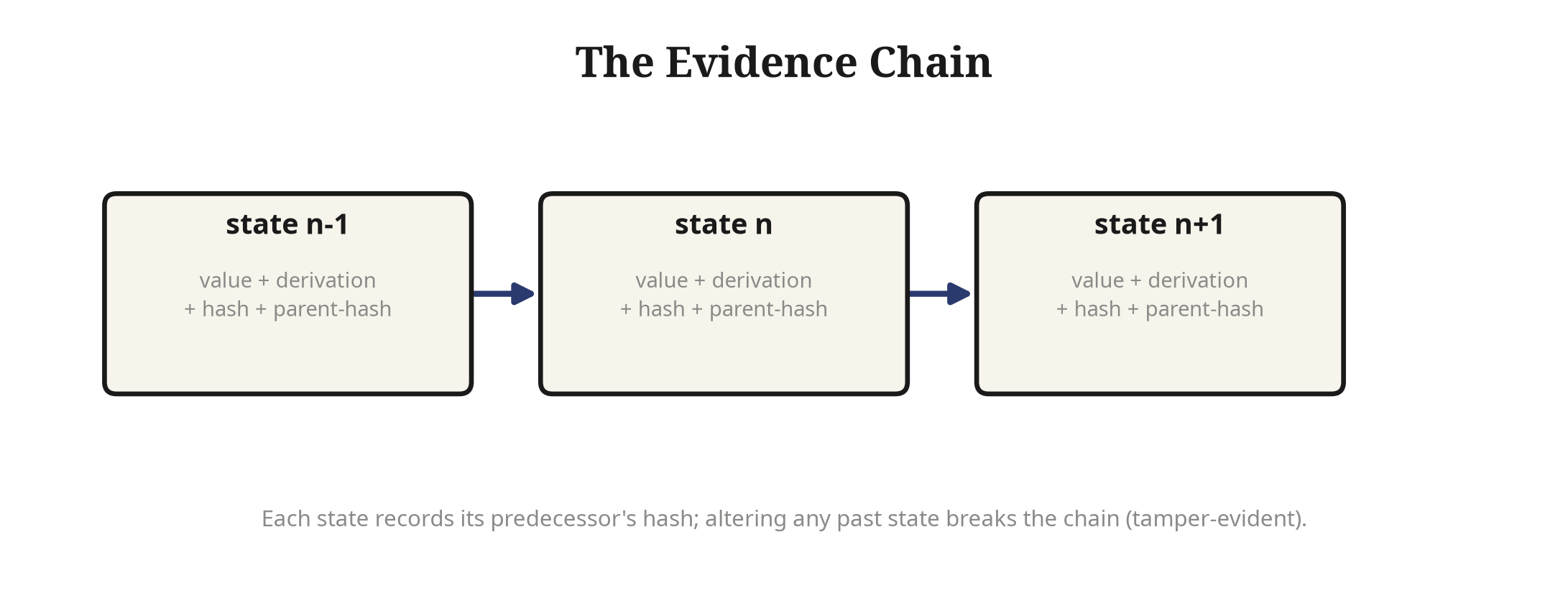
METHOD. Preserve state as append-only evidence packets: each accepted state stored with its inputs, operation, validation results, and a content hash, added to the record rather than replacing what came before. Raw source data stays immutable; derived artifacts can be regenerated from it. The quantum estimator's Preserve stage is a precise template: it writes an append-only cycle artifact containing the cycle identifier, the parent cycle's hash, timestamps, the inputs and outputs, the validation metrics, the decision, and the artifact's own hash — while keeping raw measurement data immutable so that derived states can always be regenerated from the raw record.[35] The parent-hash link is what turns a pile of snapshots into a verifiable chain.
#Boundary note
INTERPRETATION. Preservation is not hoarding. Keeping everything forever with no structure is nearly as useless as keeping nothing, because unstructured preservation cannot be recovered from — you have the data but not the ability to find or verify the piece you need. The interpretation I hold: preserve what makes a state recoverable and auditable — the derivation, the validation, the predecessors, the hashes — structured so that recovery (Chapter 6) can actually succeed. The test of good preservation is not volume; it is whether a future recovery can reconstruct and verify a past state from what you kept.
#Applied CASE
CASE. The Odisena governance chain preserves predecessor amendments verbatim and then regenerates the tracker and dashboard artifacts from them, so that advancing the chain never destroys its history. When a stale expansion of a term once appeared in creative work, the response was not to silently edit the text but to preserve the prior version and issue an explicit correction log — the erroneous state kept, marked, and superseded rather than erased.[36][37] This is preservation as the foundation of trust: because the predecessor and the correction both survive, anyone can audit exactly what was wrong, when, and how it was fixed. A silent edit would have produced a "correct" text with no evidence, which is to say, a text you would have to take on faith.
#Failure mode
The failure mode is the silent overwrite: replacing a state in place, discarding its predecessor and its provenance, so that the new state looks authoritative but carries no evidence and cannot be reversed. It is seductive because the result looks clean — no messy history, just the current correct value. But it destroys auditability (you cannot show how the value was reached), recoverability (you cannot roll back), and trust (others must take the value on faith). The fix is append-only discipline: new states are added, predecessors are retained and marked superseded, and corrections are explicit rather than silent.
#Reusable protocol — The Evidence-Pack Specification
For every accepted state, preserve as an append-only packet:
- The value/state itself.
- The derivation — inputs and operation that produced it.
- The validation evidence — which checks ran and their results.
- The predecessors — enough prior state to recompute and reverse.
- Integrity — a content hash, and a link to the parent state's hash (forming a chain).
- Immutability rule — raw sources are immutable; derived artifacts are regenerable; nothing is overwritten in place; corrections are appended and marked.
#Validation questions
- For your most recent accepted state, is its full provenance preserved, or only the value?
- Could a stranger verify one of your states from what you preserved, without trusting you?
- Do your states link to their predecessors so that a chain can be verified?
- When you correct something, do you overwrite it, or append a correction and preserve the error?
#The hash chain as a trust technology
FACT. The parent-hash link mentioned above is worth understanding in its own right, because it is one of the most elegant trust technologies humans have devised, and it is exactly the structure that makes a preserved sequence tamper-evident. The idea: each preserved state includes a content hash — a short fingerprint computed from its contents such that any change to the contents changes the fingerprint — and each state also records the hash of its predecessor. Because each state's own hash depends on the predecessor hash it contains, the hashes form a chain in which altering any past state changes its hash, which changes the successor's recorded parent-hash, which changes the successor's own hash, and so on all the way to the present. You cannot quietly alter a single past state without breaking every hash after it. The chain does not prevent tampering; it makes tampering detectable, which for an evidence store is exactly what you want: not a lock, but a seal that visibly breaks.
METHOD. This is why the evidence packets of a governed engine link to their predecessors by hash and not merely by reference. A plain reference ("this state came after that one") can be edited freely; a hash link cannot be edited without detection. When the quantum estimator's Preserve stage records a parent-cycle hash alongside each cycle's own hash, it is building exactly this tamper-evident chain, so that the entire history of accepted cycles is not just preserved but verifiably preserved — anyone can recompute the chain and confirm that no past cycle has been silently rewritten. The same structure underlies version-control histories and distributed ledgers, and it is available to any system willing to hash its states and link them. It converts "we preserved the history" from a promise into a checkable fact.
#Immutability of the raw, regenerability of the derived
INTERPRETATION. Preservation has a subtle two-layer structure that is easy to miss and important to get right: the raw layer must be immutable, and the derived layer must be regenerable, and these are different disciplines serving different purposes. The raw layer is the ground truth — the original measurements, the source inputs, the un-interpreted record — and it must be immutable because it is the thing everything else is derived from and checked against; if you can alter the raw record, you can alter reality itself as the system knows it, and no downstream check can catch you, because the checks all reference the raw record. The derived layer is everything computed from the raw — the interpretations, the summaries, the artifacts — and it must be regenerable rather than immutable, because it will legitimately change as your methods improve, and the way it changes safely is by being recomputed from the immutable raw record rather than edited in place. Confusing the two layers is a common and serious error: teams either mutate their raw record (destroying ground truth) or treat their derived artifacts as immutable (freezing in errors they can no longer correct cleanly).
The quantum estimator's preservation discipline draws this line explicitly: raw detector data are kept immutable, while derived states can be regenerated from the raw record and the versioned model. This is exactly right, and it generalizes to every preserving system. Your raw inputs — whatever your system's equivalent of detector readings is — are sacred and unchangeable; your derived outputs are disposable and rebuildable. When a derived output is wrong, you do not touch the raw record (it was not wrong) and you do not edit the derived output in place (that would diverge it from the raw); you fix the method that derives outputs from raw, and regenerate. This two-layer discipline is what lets a system both preserve an unimpeachable record of what actually happened and freely improve its interpretation of that record over time — immutable truth, regenerable understanding. A system that keeps only derived artifacts, with no immutable raw layer beneath them, has nothing to regenerate from, and so its corrections are just more patches; a system that keeps raw and derived properly separated can correct forever without ever losing or falsifying its ground truth.
#Bridge
Preserved states are evidence packets, linked into a chain. But a chain of packets is not yet legible — you cannot navigate it, query its status, or see the sequence at a glance without an index. The final beat before the gate is Track: giving the preserved sequence an append-only ledger of index, timestamp, version, and status, so the living system can be read.